Why Smart Home Devices Restore Balance to Your Daily Life
Disclaimer: This article only analyzes daily life and home space balance based on traditional oriental objective material operation rules. No metaphysics, numerology, fortune-telling or superstitious content is involved. All content is objective life demand analysis and real user product experience.
Morning chaos. You wake up to an alarm blaring from a phone buried under a pillow, then spend ten minutes hunting for your keys because the hallway light was off. Your coffee maker is downstairs, your calendar is across town, and by the time you gather yourself for the day, the morning breeze that once felt fresh now feels like it came from somewhere else entirely. This is the subtle energy shift that happens when our living spaces stop serving us and start creating friction with every routine action.
Traditional home balance principles have always recognized that every object we bring into our living environment carries an invisible weight. Not a literal one, but a functional one — how much effort does it save? How much friction does it introduce? Ancient practitioners called this the yin-yang balance of household tools, the natural equilibrium between what our spaces offer and what our daily lives require. When every basic need demands a deliberate trip across the house, the energy of the room changes, and so does the rhythm of your morning. A balanced home is one where the tools you need are within reach, the lighting responds to your habits, and the information you care about appears before you have to ask for it.
Think about what a “smart home” usually looks like in practice. Lots of expensive screens, complicated setups, systems that talk to each other but not to you. The industry spent years trying to make houses connected without figuring out why they should be connected in the first place. The solution is not more devices — it is fewer, smarter devices placed where they actually matter. What I mean by smarter is not smarter at all, just smarter in the sense that they think in the direction of human habits rather than engineering specs.
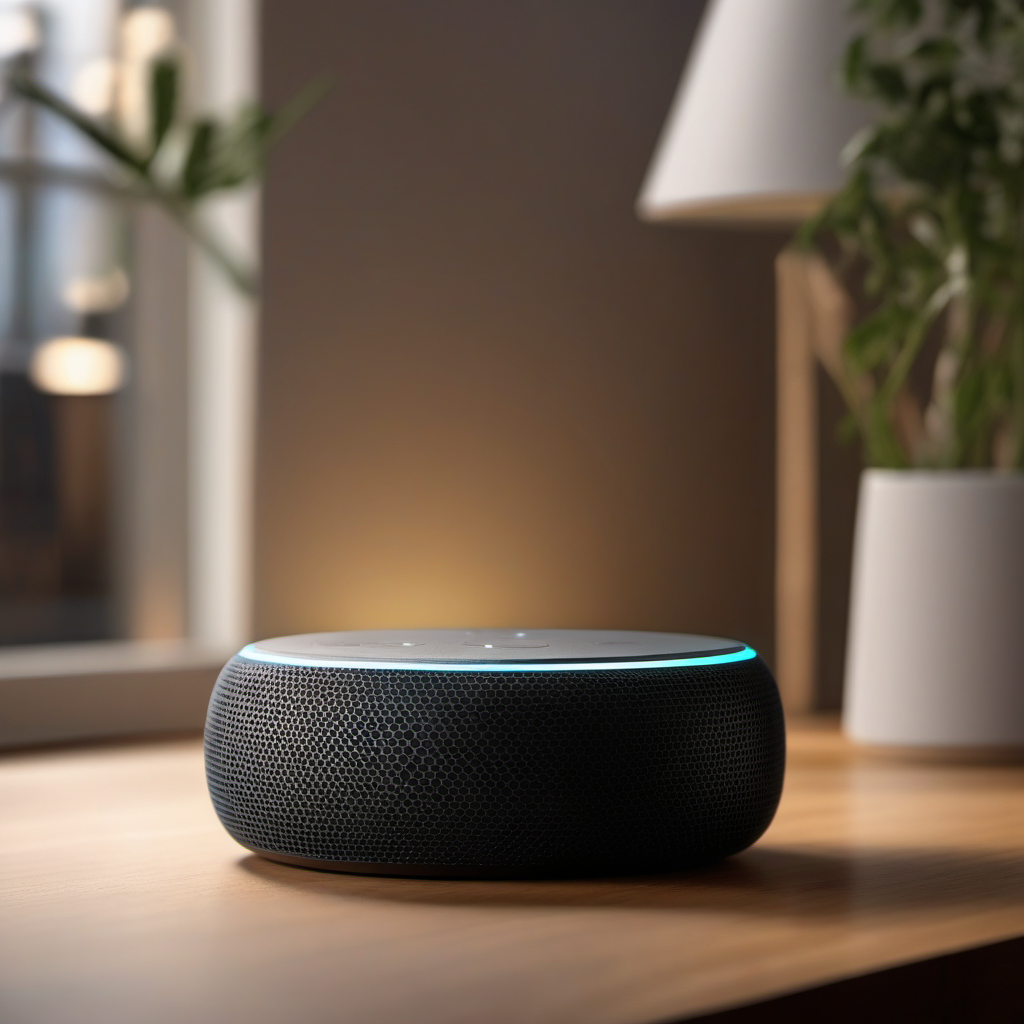
This is where the Echo Dot smart speaker with Alexa on Amazon becomes a turning point in home balance. It is the smallest device Amazon has ever put this kind of intelligence into, and it is exactly small enough to sit on any bedside table, kitchen counter, or office desk without demanding a place of honor in your room. The design language is understated — a fabric-covered sphere that looks more like a decorative object than a piece of technology. This matters more than it sounds, because the best smart home tools disappear into the background of your routine. You stop noticing them and start relying on them, and that is the moment the space around you starts working for you instead of against you.
According to long-term owner reports, the real surprise with devices like the Echo Dot is not the initial novelty of voice commands, but the slow accumulation of small conveniences that add up to something bigger than any single feature. A typical morning routine described by owners: asking for the weather, the day’s schedule, and a brief summary of the day. It is more efficient than opening a calendar app and more natural than setting up a physical planner, requiring nothing more than a voice command. The sound quality is consistently rated as impressive for a speaker this size, which matters because nobody wants tinny audio from a room’s music source. Long-term owners report that it never demands a manual, never needs a manually managed app update, and never ends up as an expensive paperweight gathering dust in a corner.
Every device has its limitations, and the Echo Dot is no exception. It is not the loudest speaker if you need room-filling audio at high volumes. It does not have a screen, which means visual information has to come from your phone instead of being right there in front of you. The microphone array is good but not perfect in rooms with lots of ambient noise — you may have to repeat yourself if the TV is blasting or the kitchen fan is running. These are not deal-breakers, but they are real trade-offs worth considering. It works best for voice interaction, not visual interaction, and the best environment for it is a room where the ambient noise level is within a reasonable range.
This device is ideal for three types of people. First, the first-time smart home buyer who wants to understand what the experience feels like without committing to a full connected ecosystem. Second, people who already have Echo devices and want to add more rooms without investing in screens. Third, people who value simplicity over complexity and prefer asking a question to navigating through five menus. It is not recommended for anyone who primarily interacts with their home systems visually or who needs a display for video calls and smart home camera feeds.
Building a balanced home does not require you to replace everything overnight. It starts with a single device that proves the concept — one tool that genuinely makes the daily friction disappear. The Echo Dot smart speaker for Alexa home automation on Amazon offers exactly that starting point. Try it on your nightstand, listen to how it changes the energy of your morning routine, and if it fits, expand slowly from there. The space around you was always meant to serve you, not challenge you with unnecessary obstacles between what you want and what you get.
If you prefer to focus on a specific setup — perhaps one designed for a home office rather than a bedroom — the same principle applies. The Echo Dot smart speaker for Alexa in office environments on Amazon adapts naturally to different rooms because it is not a room-specific device. What matters is the habit you build around it, not the room it sits in.
Affiliate Disclosure: This post contains affiliate links. I may earn a small commission at no extra cost to you when you purchase products through my affiliate links. #ad
1 thought on “Why Smart Home Devices Restore Balance to Your Daily Life”
Comments are closed.